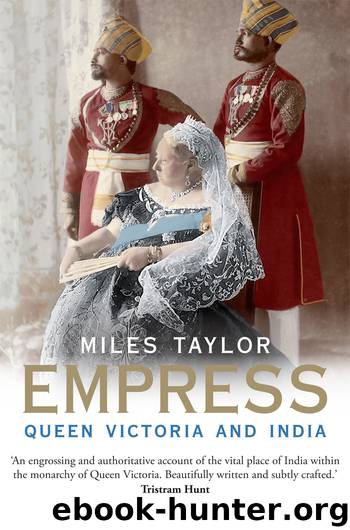
Empress by Miles Taylor
Author:Miles Taylor
Language: eng
Format: epub
ISBN: 9780300118094
Publisher: Yale University Press
Ripon engel appan20
There were not many radical viceroys in the British Raj. Arguably, there was only ever one: George Robinson, the 1st Earl of Ripon. Sandwiched between two Tories, Lords Lytton and Dufferin, and selected by William Gladstone, whose own tiptoeing towards radicalism had by the 1880s become a sprint, Ripon’s appointment ‘astounded’ Queen Victoria. Never before had she had to contend with such a clean slate: a new Liberal government at home and a new Liberal government in India. Elevated to the House of Lords in 1871, Ripon’s politics and his faith seemed to take one unconventional turn after another, as he converted to Catholicism, embraced the co-operative movement, and supported the moderate strain of Irish nationalism.21 Arriving in India in June 1880 he made it clear that he had come with his liberal baggage intact. The new viceroy told the Poona Sabha that he would honour Lord Canning’s treaty sannads granted to the Indian chiefs in the 1860s. He promised the Corporation of Calcutta that he would treat the queen’s subjects in India ‘with the same equal justice, the same consideration, and the same regard for their interests’ as ‘the Englishmen who dwell most near to her throne’. And he assured the Mahomedan Literary Society of Calcutta that he would act ‘strictly upon the Queen’s Proclamation’ in regard to religious impartiality.22 Ripon quickly got down to work, undoing some of Lytton’s legislation, and introducing much of his own. Out went the unpopular (and largely ineffective) Vernacular Press Act of 1878. In came India’s first factory legislation. Commissions were tasked with reforming agricultural conditions in Bengal, and improving education. Ripon tampered with the Arms Act, another Lytton measure of 1878, and the bane of Indian nationalists. Fighting off the views of his own council, he reduced the salt tax.23
Two measures in particular cemented Ripon’s reputation as a reformer. Firstly, in May 1882, Ripon’s council introduced an elective element to local government in the provinces of India, devolved responsibility for public works, education and financial administration, and gave further tax-raising powers to municipal, district and local boards.24 It was the first major concession of representative institutions by the British in India, although over time the process of adoption was drawn out and choked by official resistance. ‘Ripon’ town halls and other municipal edifices were erected, most strikingly at Madras, but also at Multan in the Punjab. Secondly, and more controversially, Ripon attempted to resolve the issue as to whether native Indian judges could preside over the trials of Europeans in the district courts. The Criminal Procedure Amendment Bill, or the ‘Ilbert bill’ as it quickly became known, denoting the name of the legal member of the Viceroy’s Council, Courtenay Ilbert, who was charged with drafting the legislation, broke with tradition. Since Thomas Babington’s Macaulay’s ruling of 1836 – the so-called ‘Black Acts’ – native magistracy had operated in civil cases in the provincial or mofussil courts, although not in the presidency towns of Bombay, Calcutta and Madras. But native judges were effectively excluded from criminal courts with jurisdiction over Europeans.
Download
This site does not store any files on its server. We only index and link to content provided by other sites. Please contact the content providers to delete copyright contents if any and email us, we'll remove relevant links or contents immediately.
Fanny Burney by Claire Harman(26602)
Empire of the Sikhs by Patwant Singh(23085)
Out of India by Michael Foss(16853)
Leonardo da Vinci by Walter Isaacson(13336)
Small Great Things by Jodi Picoult(7141)
The Six Wives Of Henry VIII (WOMEN IN HISTORY) by Fraser Antonia(5515)
The Wind in My Hair by Masih Alinejad(5095)
A Higher Loyalty: Truth, Lies, and Leadership by James Comey(4963)
The Crown by Robert Lacey(4814)
The Lonely City by Olivia Laing(4801)
Millionaire: The Philanderer, Gambler, and Duelist Who Invented Modern Finance by Janet Gleeson(4478)
The Iron Duke by The Iron Duke(4354)
Papillon (English) by Henri Charrière(4274)
Sticky Fingers by Joe Hagan(4198)
Joan of Arc by Mary Gordon(4110)
Alive: The Story of the Andes Survivors by Piers Paul Read(4031)
Stalin by Stephen Kotkin(3965)
Aleister Crowley: The Biography by Tobias Churton(3640)
Ants Among Elephants by Sujatha Gidla(3467)
